Posts

2021 Workforce Data Revisions: Job Losses Were Not Quite as Sharp as Previously Indicated

Image
Each month estimates from two surveys provide the most current indications of workforce conditions. The Current Population Survey, often referred to as the “household survey,” is the primary source for estimates of unemployment and labor force participation of the population. The Current Employment Statistics “payroll survey” is the source for estimates of the number of jobs in many nonfarm industries.  In March of each year, estimates from those programs are revised based on lagging but more complete data. Compared to previously published estimates, revised data for 2019 and 2020 indicates that: Unemployment was lower for most months Labor force participation was higher in 2019 and early 2020, before the pandemic disrupted labor market activity, and mostly lower for the remainder of the year The number of nonfarm payroll jobs was slightly higher in 2019 and early 2020, and significantly higher for much of the rest of the year Data cited in this brief is seasonally adjusted....

Occupational Employment Outlook to 2028

Image
Our recent Employment Outlook article focused on how an aging population is constraining the size of the labor force in Maine. Though a small decrease in employment is expected for the period from 2018 to 2028, over 75,000 job openings are projected each year. This article focuses on the number and rate of openings that are expected among occupations and how the structure of employment is expected to continue to gradually shift. Changes in demand for goods and services and in the competitive landscape cause employment to rise in some companies and industries and decline in others. This impacts the level of demand for workers among occupations. Rising or declining employment in banks, for example, impacts demand for tellers and loan officers. At the same time, the occupational distribution of jobs within industries continually shifts as technology and work processes evolve and alter how functions are accomplished. Returning to our banking example, the shift to more transactions process...

Maine’s Labor Market During the Pandemic: Impact by gender

Image
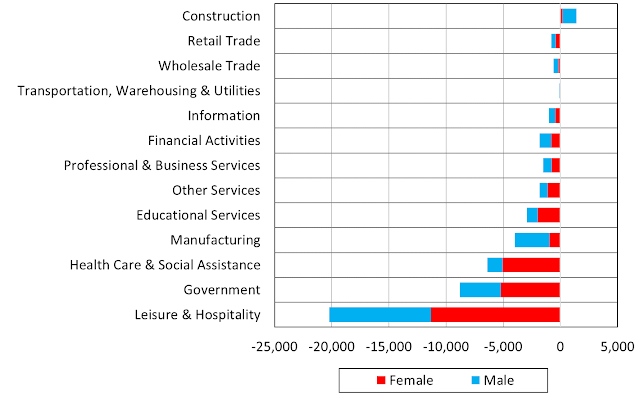
The pandemic had a dramatic impact on the labor market through most of 2020. A previous article, available here , examined which sectors have been most impacted and how this period differs from the last recession. This article examines the differing impact by gender in the period from February, just before the COVID-19 virus caused business closures and alternative work arrangements, through December 2020. Change in Jobs by Gender by Sector in Maine February to December 2020 Source: Maine Department of Labor, Center for Workforce Research and Information, Current Employment Statistics Share of employment by gender obtained from the Census Bureau Quarterly Workforce Indicators In the ten months through December there was a net decrease of 48,400 jobs. Of that, we estimate that 27,600 jobs were lost by women and 20,800 by men. The 57 to 43 percent disparity is because women comprise a majority of jobs in the sectors most impacted by the pandemic: leisure and hospitality, educational serv...

Maine’s Labor Market During the Pandemic: Job impact by sector and a comparison to the last recession

Image
The COVID-19 pandemic led to unprecedented disruptions in the labor market, beginning in March of 2020. From February to April, 104,500 nonfarm jobs were lost, about 16 percent of the statewide total. The 532,800 jobs in April was the lowest monthly total since August of 1994.  Job Impact by Sector Job losses were heavily concentrated in sectors of the economy in which goods and services are delivered in-person and where close contact with customers or coworkers is required. Most job losses in March and April occurred in the leisure and hospitality, health care and social assistance, and retail trade sectors, as well as in educational services, which is spread across local and state government -- public schools, universities and community colleges -- and private schools – both K-12 and higher ed. Those sectors were impacted by a combination of public safety measures and changes in the types of activities that people engaged in as a result of the pandemic.  While most sectors o...

Employment Outlook to 2028

Image
Workforce conditions in Maine were very tight with historically low unemployment in the four-year period through the beginning of 2020. The COVID-19 pandemic sent the economy into a steep decline in the spring, and now, in the middle of 2020, the recovery is underway. At this point, it is unclear how long full recovery will take or what all the long-term impacts will be, though there are likely to be many. This forecast covers the period from 2018, the base year, to 2028. It does not include years in between, though we cannot ignore the fact that employment today is well below 2018 levels. It considers some of the longer-term impacts we expect in the aftermath of the pandemic, though the full range of impacts cannot be fully understood at this point. Long Term Employment Growth Context The rate of change in employment in Maine has varied significantly over the last seven decades, with long periods of little change and of rapid growth. In both cases, the number of births was the key fac...

Understanding the Employment Situation in Maine

Originally Published May 22, 2020. Updated on June 19, 2020 On Friday June 19, the Center for Workforce Research and Information (CWRI) and U.S. Bureau of Labor Statistics (BLS) released May workforce estimates for Maine. These include estimates of the unemployment rate and the change in nonfarm payroll jobs. The COVID-19 pandemic caused unprecedented job loss in Maine and the nation, though nonfarm payroll jobs began to show signs of recovery in May. The pandemic has created significant data collection and estimation challenges. This document provides information on how these estimates are derived, what some of the challenges were for collection and estimation, and then answers some questions we expect to arise. How this data is collected The U.S. Bureau of Labor Statistics enters into cooperative agreements with state workforce agencies to collaboratively produce and disseminate workforce data. Two programs, Current Employment Statistics (CES) and Local Area Unemployment Statis...

Understanding the Employment Situation in Maine

On Friday May 22, the Center for Workforce Research and Information (CWRI) and U.S. Bureau of Labor Statistics (BLS) released April workforce estimates for Maine. These include estimates of the unemployment rate and the change in nonfarm payroll jobs. The COVID-19 pandemic caused unprecedented job loss in Maine and the nation in the last two months. It also created significant data collection and estimation challenges. This document provides information on how these estimates are derived, what some of the challenges were for collection and estimation, and then answers some questions we expect to arise. How this data is collected The U.S. Bureau of Labor Statistics enters into cooperative agreements with state workforce agencies to collaboratively produce and disseminate workforce data. Two programs, Current Employment Statistics (CES) and Local Area Unemployment Statistics (LAUS), are designed to provide a monthly indication of workforce conditions and trends. Data from those prog...